Tiny Experiments
Rob Coles
Tiny Experiments Overview
I got the inspiration for tiny experiments from Anne-Laure Le Cunff’s book Tiny Experiments . There is a lot more than just tiny experiments in the book, and I strongly recommend reading the whole thing.
The appeal of a tiny experiment rather than a goal for me is that it comes from a place of curiosity - a “maybe” or a hypothesis. There is no failure in a tiny experiment. Only learning.
The basic format of a tiny experiment is distilled down to:
I will [action] for [duration].
The book refers to this as a pact.
The book also uses the word “PACT” as an acronym and defines it as:
- Purposeful - Feel exciting and provide meaning through learning.
- Actionable - Something you can actually do.
- Continuous - Simple and repeatable to be able to collect meaningful data.
- Trackable - Should ideally be able to state “Have I done it or not”.
So the tiny experiment should ideally be all of these things. I do apply a bit of flexibility to these rules for my experiments.
To help me think this through, I have set up a template in Obsidian and I use this to start all of my tiny experiments.
Tiny Experiments template
This is the template I use when I start a tiny experiment:
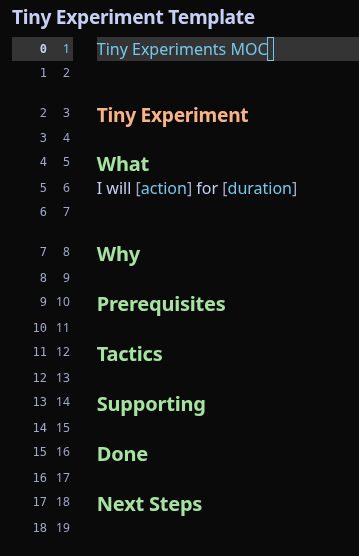
Using this template makes me think about what the “maybe” or hypothesis is, and establishes the boundaries and pre-requisites.
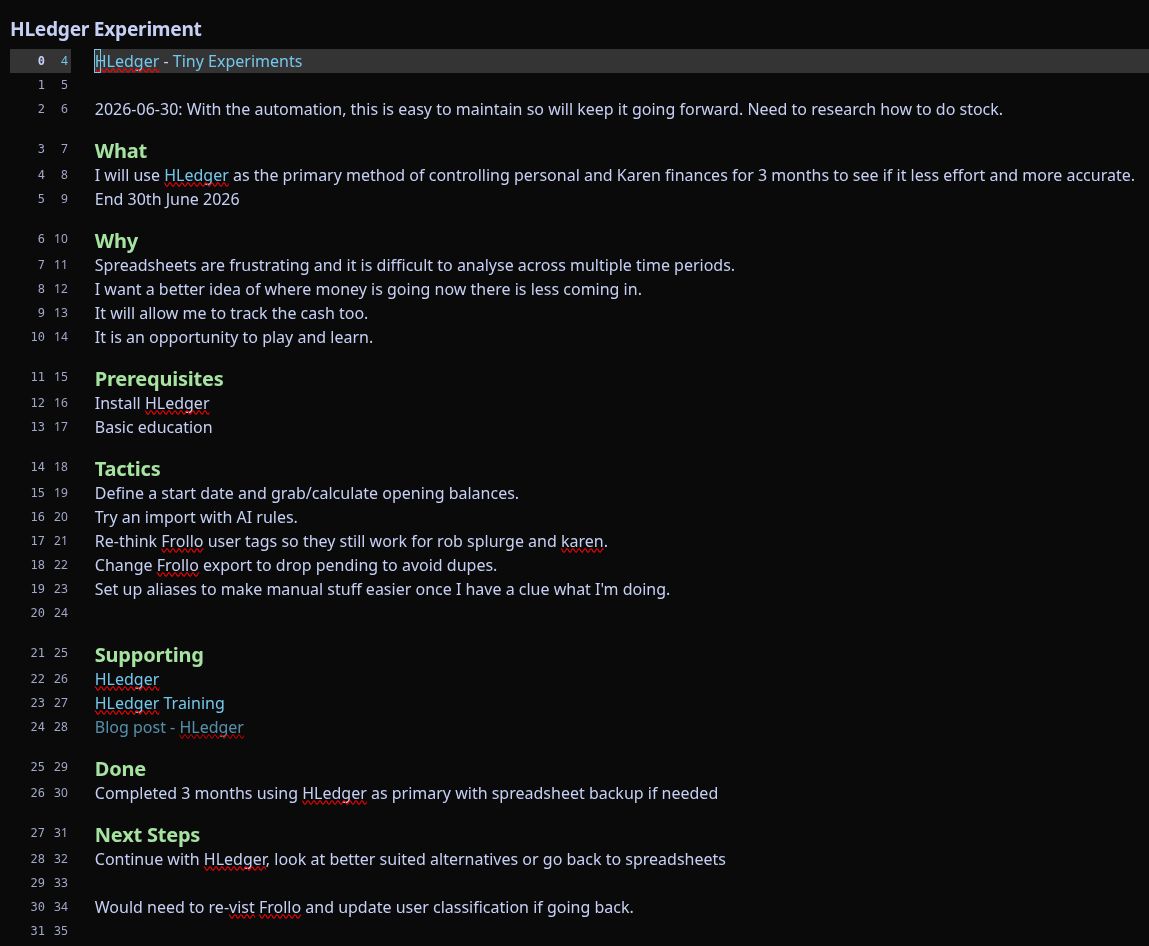
This is an example of a completed template, which I used for my HLedger personal finance experiment earlier this year.
Tiny Experiments so far
I was so happy with the effectiveness of the tiny experiments I had tried last year that I set aside 6 of my “26 for 2026” tasks to be tiny experiments. I only had 3 specifically planned at the start of the year, and the other 3 running this year so far have emerged through asking the “Maybe I’d be more productive” or “Maybe it would be easier if” sort of questions. I’ve listed the ones I’ve tried so far, to give you some ideas, and there will be more. The list is roughly in chronological order and I sometimes run multiple experiments at the same time.
- Mint Linux Experiment - “I will try using Mint Linux as my daily desktop for a month”
- Meditation Experiment Sept 2025 - “I will meditate using the Insight app for at least 5 days a week for the next 4 weeks”
- Arch Linux Experiment - “I will try using Arch Linux as my daily desktop for a month”
- Journalling experiment - “For 4 weeks I will journal for at least 5 days a week”
- Sway DE Experiment - “I will run with Sway for 4 weeks as my daily driver”
- Ardour - “I will use Ardour for recording music for a month”
- Back to Plasma Experiment - “I will return to using KDE Plasma for 2 weeks having been immersed in Sway”
2026
- NeoVIM Experiment - “I will use NeoVIM for editing and wherever possible use VIM keybindings elsewhere for January 2026”
- HLedger Experiment - “I will use HLedger as the primary method of controlling personal and business finances for 3 months”
- VIM Key Bindings Experiment - “I will use VIM key bindings wherever possible for January 2026”
- Meditation Experiment 2026-Q1 - “I will meditate at least 5 times a week for 3 months”
- Obsidian Theme Experiment - “I will work with different themes for 2 weeks from 24 Aug to 03 Sept 2026”
- Theming experiment - “I will implement theming to my days/weeks for 2 months, starting 1st August and ending 30th Sept. 2026”
I have excerpted the pact a bit, I will often add the reason so the full pact sometimes contains some of the “maybe” I’m investigating, e.g. the full pact for the Back to Plasma experiment is:
“I will return to using KDE Plasma for 2 weeks having been immersed in Sway. At the end of 2 weeks I’ll see if I want to return to Sway, stick with Plasma or try something different. Being mindful that it took some fiddling to get Sway working.”
Next steps
The tiny experiments approach is still appealing and I am going to continue to use it to explore my “maybe” questions. I have two tiny experiments running at the moment: Theming and Obsidian Theme.
As you can tell from the list above, the experiments do not always conclude with a “positive” result. The things I found out doing the Linux Mint experiment, for example, resulted in me abandoning Mint and trying an Arch-based version of Linux instead, but without trying Mint, I wouldn’t have understood the advantages and disadvantages.
Please give it a go!
Resources:
Tiny Experiments book
Setting better goals with PACT
YouTube
My Obsidian-related code